![IBacademy_Logo_blau[496]](https://www.ibsolution.com/hs-fs/hubfs/IBacademy_Logo_blau%5B496%5D.jpg?width=200&name=IBacademy_Logo_blau%5B496%5D.jpg "IBacademy_Logo_blau[496]")
Enterprise Architecture Management (EAM) is a discipline that strategically links business, processes, data, and IT architectures. In the context of a transformation, EAM acts as a link between the business goals a company sets for itself and the technology decisions that are intended to help achieve those goals. EAM is also extremely helpful in the introduction of SAP S/4HANA, ensuring that the ERP transformation is a success.
Still have the SAP S/4HANA transformation ahead of you?

Enterprise Architecture Management is optimally supported by SAP LeanIX as a software tool. The SaaS solution enables companies to visualize, evaluate, and control the transition to their target architecture. SAP LeanIX provides guidance on the software applications in the organization and shows how they are related and linked to each other.
Processes and architecture work hand in hand
In addition to the IT infrastructure, the redesign of processes – combined with a potentially stronger focus on the SAP standard – is also a fundamental component of an ERP transformation. Consequently, enterprise architecture management and process transformation only work together. For a successful transformation, both topics must be considered jointly. It is not enough to simply define and optimize processes –companies must also ensure a stable application architecture as a foundation. Processes and architecture are, in a sense, two sides of the same coin.
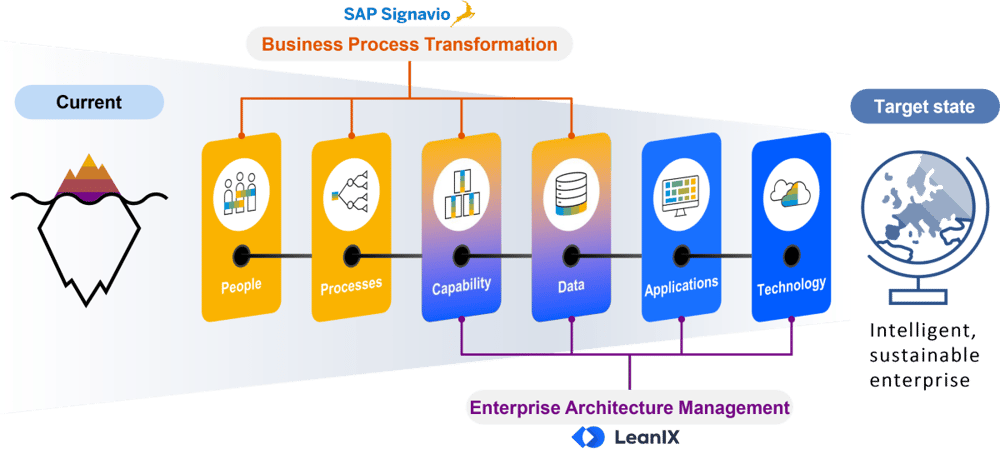
The interaction between SAP Signavio and SAP LeanIX (source: SAP)
Accordingly, the SAP portfolio also includes tools for both dimensions. SAP Signavio supports business process transformation and can be used to model and visualize business processes – linked to the people in the organization, the business functionalities, and the data objects. SAP LeanIX, in turn, builds on this and maps the business functionalities and data objects to the applications and technology. The goal is to create a transparent overall picture in order to make better decisions.
Interaction in the six phases of ERP transformation
The interaction between SAP Signavio and SAP LeanIX is also evident in the six phases of ERP transformation defined in the SAP Activate methodology.

(Source: Own illustration based on SAP)
In each phase, SAP Signavio and SAP LeanIX complement each other and bring together the dimensions of processes and architecture. Based on an analysis of the current processes and architecture (Discover), a business case is created for both levels (Prepare). This is followed by the definition of the target processes and architecture (Explore), the implementation of process improvements, and the definition of the transformation roadmap (Realize). The final steps are the go-live (Deploy) and the continuous further development of the processes and architecture (Run).
Fact sheets and attributes: Characteristics of the data model
The SAP LeanIX data model is based on fact sheets, which are used to inventory applications. The individual fact sheets – for example, Data Object, Interface, Business Capability, Organization, Provider, IT Component, Objective, and Initiative – are interrelated. This means that an application can provide or consume an interface and use data objects for reading or writing.
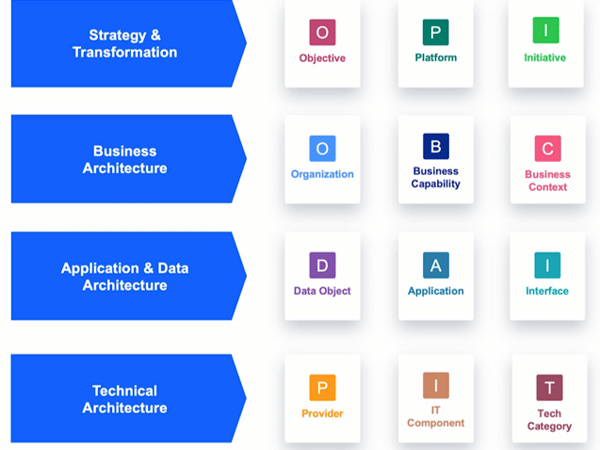
The fact sheet types in SAP LeanIX (source: SAP)
The corresponding attributes are available within the fact sheets. A distinction must be made between standard attributes, which are contained in all fact sheets, and specific attributes, which are defined for each fact sheet type. In addition, the data model can be expanded with individual attributes if company-specific information needs to be added. The initial maintenance of the fact sheets can be done manually, via Excel import, or as a direct import from SaaS applications via the “SaaS Discovery” interface. To enrich the data and keep it up to date, collaborative maintenance via workflows or surveys directed at the business departments is a suitable approach.
The extensive data model with its defined links can quickly increase the complexity of SAP LeanIX. Companies should therefore first consider scenarios that promise quick wins. This involves defining a pilot project with a realistic scope that promises rapid added value with a manageable budget and reasonable effort. Such a pilot is also suitable for generating a pull effect for SAP LeanIX in the organization and winning over stakeholders for follow-up applications.
What is a suitable pilot project?
A conceivable starting point for a pilot project is the development of applications, followed by the linking of business capabilities and organizations, and, if necessary, IT components. The motto here should be “less is more.” Trying to model the entire IT architecture of the company in the very first step is not a good idea. Instead, the focus should initially be on a line of business with critical applications or on an ERP initiative. Once this section has been modeled for the respective use case, the scope can be expanded in the next step.
In addition, it is advisable to use the dashboards and reports included in SAP LeanIX to visualize the results for stakeholders. A typical report in an initial project is the “Application Landscape Report.” It can be used to systematically document the applications within the organization based on various criteria. The goal is to create transparency with regard to the IT landscape, taking into account aspects such as business relevance, usage, and dependencies. This allows risks and cost drivers to be identified. The results are also suitable for deriving further use cases, such as the consolidation of applications (streamlining).
Conclusion: Holistic view of processes and technology
SAP LeanIX proves to be a key tool for ensuring transparency, structure, and controllability in an SAP S/4HANA transformation. Integration with SAP Signavio provides a holistic view of processes, applications, and technological dependencies – a prerequisite for making informed decisions and identifying risks at an early stage. A clearly defined pilot project helps to highlight the benefits of the solution, build acceptance, and pave the way for further use cases. Companies that want to successfully shape their ERP transformation get more than just a tool with SAP LeanIX; they get a strategic compass for their future IT architecture.