![IBacademy_Logo_blau[496]](https://www.ibsolution.com/hs-fs/hubfs/IBacademy_Logo_blau%5B496%5D.jpg?width=200&name=IBacademy_Logo_blau%5B496%5D.jpg "IBacademy_Logo_blau[496]")
Many companies are using artificial intelligence (AI) – as a co-pilot, an add-on, or an isolated assistance tool. But reality shows that individual AI functions do not generate sustainable added value unless they are embedded at the core of business processes.
With the North Star architecture, SAP is pursuing an approach that views AI not as a supplement, but as a structuring layer for the entire enterprise. The difference is fundamental: It is no longer about automating individual tasks using AI. It is about structuring a company so that it functions as a connected, learning system in which artificial intelligence can operate across applications and lines of business. This is how the Autonomous Enterprise emerges.
Would you like to learn more about the Autonomous Enterprise?

Four layers for one goal
Anyone who wants to manage critical business processes with AI needs an architecture that is not only intelligent but also manageable. The North Star architecture consists of four interdependent layers that, working together, provide the technical infrastructure for enterprise-wide AI deployment.
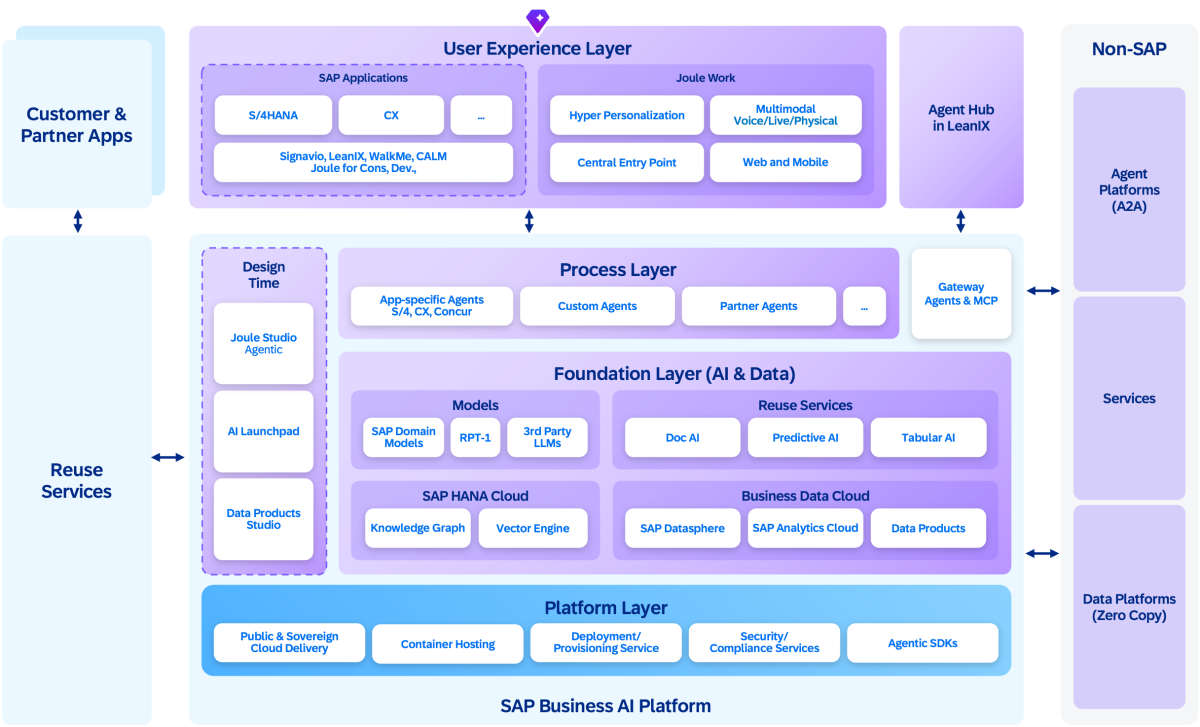
The various layers of the North Star architecture (Source: SAP SE)
User experience layer
In the user experience layer, users will in the future specify their intent in natural language – and the system will handle the execution. The user describes what they want to achieve, and the actual implementation takes place in the background. SAP Joule acts as a conversational AI interface and serves as the unified access point for users. The key difference from the previous user experience is that users no longer have to navigate back and forth between different applications.
Process layer
At the process level, a true paradigm shift is taking place in application architecture: Applications are no longer designed primarily for human users but are intended first and foremost to provide functions for AI agents. The AI agents plan cross-system processes and execute them autonomously, collaborating with other agents in the process. A unified development environment supports and simplifies the creation of applications and AI agents.
Foundation layer
In a sense, the foundation layer forms the heart of the North Star architecture. This is where data and AI converge to form the intelligent core of business processes. It’s not just about making harmonized and processed data available for AI use, but also about providing the necessary business context and semantics so that AI agents can recognize the relevant connections and draw the right conclusions from them. This is the key prerequisite for the effectiveness of enterprise AI.
Platform layer
Applications, agents, and workflows are executed at the platform level. SAP Business Technology Platform (BTP) offers combinable services for data management, application development, integration, and security. As the lowest layer, the platform layer provides the runtime environment and governance for controlled, secure execution. Without this layer, enterprise-wide, cross-system deployment of AI would be inconceivable. This is because the platform layer provides the foundation for reliability, compliance, and security.
Governance: AI agents as independent actors
Within the framework of the North Star architecture and the Autonomous Enterprise, AI agents are not viewed as passive tools. Rather, they are regarded as independent actors with their own identity, defined authorizations, and audit trail – just like human employees. In practice, this has certain implications: AI agents are granted access only to the resources necessary for their tasks. Their actions must be traceable and auditable at all times. The clear principle behind this is that artificial intelligence must never know more than the human on whose behalf it acts. It operates exclusively within the security context of the authenticated user.
Companies must make their system and data landscape AI-ready
The North Star architecture describes the strategic path along which SAP is further developing its entire platform – from applications through SAP Business Technology Platform to SAP Joule. For companies looking to transform and modernize their SAP landscape, this means: Today’s decisions – regarding data models, interface design, authorization concepts, and so on – lay the foundation for tomorrow’s AI capabilities. A clean, semantically enriched data foundation and sophisticated integration are not optional extras, but rather essential prerequisites for future competitiveness.
Assessment from an SAP partner’s point of view
What sounds convincing in theory still needs to prove itself in practice. After all, the reality is that the elements of the North Star architecture are, for the most part, still just announcements. As of today, the components of the SAP Autonomous Suite are not yet available. SAP is therefore urgently required to follow up its ambitious statements with action and deliver the promised functionalities so that the widespread use of AI within enterprises can become a reality. A clear timeline is needed, and SAP must deliver in the foreseeable future – only then will the reliability emerge that companies need to embrace SAP’s brave new world of AI.
By the way: Anyone who has been part of the SAP ecosystem for quite some time might feel a sense of déjà vu when looking at the various layers of the North Star architecture. That’s because it bears strong similarities to SAP NetWeaver, which was introduced in 2004. At the time, this was the first SAP stack with an explicit focus on technology – and there was an enormous need among companies to establish this technological foundation. With regard to the SAP Autonomous Suite and the North Star architecture, history could now repeat itself. Once again, companies are faced with the task of creating the necessary infrastructure so they can subsequently implement the innovation initiatives built upon it.
Conclusion: Setting a strategic course for the future
With the North Star architecture, SAP is establishing a clear technical framework for how agentic AI should function within a company’s core processes: not as individual features, but as a consistent, trustworthy, and controllable layer of intelligence that spans all processes. The path to achieving this requires more than just the introduction of new tools or solutions – it requires companies to engage strategically with the topics of architecture, data, and governance, and, with regard to SAP, a significantly faster pace in delivering the announced functionalities. This will ensure that the current status and the ultimate vision continue to converge and eventually merge.